

The debt burden ratio is a term commonly found in the financial industry. This ratio compares income to debt burden.
By calculating this ratio, financial institutions and banks will determine whether a person is eligible to receive a loan or not.
Let’s learn more about the debt burden ratio and how it affects your FLIN Bailout Program application in this article!
What is the Debt Burden Ratio (DBR)?
Debt burden ratio is a debt burden ratio that shows the comparison between a person’s or company’s total debt obligations and the income or net profit they have.
This debt burden ratio helps measure the ability to pay debts or determine financial stability.
A low debt burden ratio indicates a low debt burden. Conversely, a high DBR indicates a high debt burden.
From this DBR, financial institutions or banks can find out whether prospective debtors can pay monthly installments or not, as a step to prevent Non-Performing Loans (NPL) or bad debts.
DBR also helps banks or financial institutions in determining the amount of installments that customers can pay each month. To find out the debt burden ratio , usually the bank will calculate the total amount of installments and debts owned by the prospective debtor, bothcredit card, unsecured loans, and vehicle loans. If the DBR ratio exceeds the bank’s requirements, the loan application will likely be rejected.
The Role of Debt Burden Ratio
The debt burden ratio has several important roles in the financial context, such as the following:
1. Assessment of Ability to Pay
As previously discussed, the debt burden ratio is an indication of a prospective debtor’s ability to pay interest and principal on their debt.
If the DBR is very high, this could be a sign that the individual or entity is facing difficulties in paying interest and debt.
2. Assessing Debtor Eligibility
DBR’s next role is to assist banks and financial institutions in assessing potential borrowers’ eligibility for new loans and serve as a reference for determining which credit platforms are eligible. This is to prevent defaults and bad debts.
3. Used as Credit Scoring Analysis
DBR is one of the components in assessing credit scores ( credit scoring) . If the debt burden ratio is high, the higher the debt burden.
4. Helps with Financial Planning
DBR can also help us determine a safe maximum installment limit, plan debt repayment, and prioritize monthly expenses.
Also Read:The 50-30-20 Budgeting Method: Understanding the Concept and Its Benefits
Ideal Value for Debt Burden Ratio
Each bank implements a different debt burden ratio policy . A lower DBR is better, as it indicates that monthly net income is sufficient to cover debt repayments.
In general, a good DBR is in the range of 30%-40%. This means that monthly debt payments should not exceed 30%-40% of monthly net income.
However, it is important to remember that the ideal DBR value can vary depending on an individual’s financial situation, including fixed expenses, living expenses, and other economic factors.
How to Calculate Debt Burden Ratio
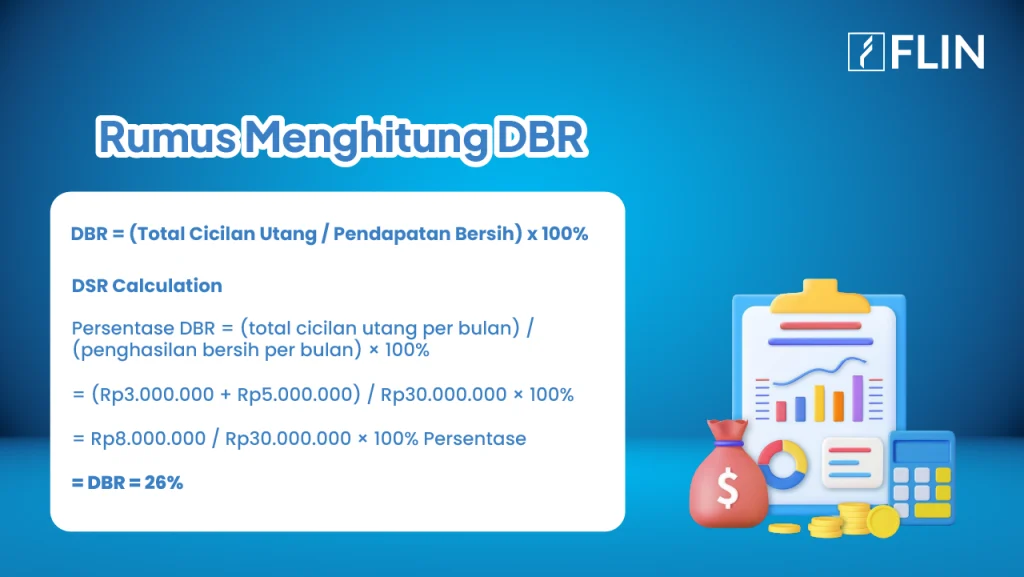
The DBR is generally expressed as a percentage. The debt burden ratio can be calculated using the following formula:
DBR = (total monthly debt installments / net income per month) x 100%
To make it clearer, let’s look at the following simulation:
Susanto has a net income of Rp30,000,000 per month. He is currently applying for a mortgage in the Bekasi area for Rp1 billion. He is known to have a total credit card loan of Rp30,000,000 with monthly installments of Rp3,000,000. He also has a car loan with monthly installments of Rp5,000,000.
From here, Susanto’s DBR calculation is:
DBR percentage = (total debt installments per month) / (net income per month) x 100%
= (Rp. 3,000,000+Rp. 5,000,000)/Rp. 30,000,000 x 100%
= IDR 8,000,000/IDR 30,000,000 x 100%
DBR percentage = 26%
So, in the example above, the debt burden ratio is 26%. This figure is still less than 30%, so Susanto’s mortgage application is likely to be accepted by the bank.
Also Read:What is a Credit Report? Understand Its Use and How to Check It Online
Factors Affecting the Debt Burden Ratio
The debt burden ratio is influenced by a number of economic and financial factors that can change over time.
Some factors that influence DBR are:
1. Amount of Debt
The amount of debt is a major factor influencing the DBR. The higher the debt, the higher the debt burden ratio .
2. Income
As income increases, the debt ratio will tend to decrease, indicating that individuals have more ability to repay debt.
3. Interest Rate
The interest rate required to pay also factors into the debt burden ratio. If interest rates rise, the interest costs on debt will increase. This can increase the debt burden ratio .
4. Macroeconomic Conditions
Macroeconomic conditions, such as economic growth, inflation, unemployment rate, can affect DBR.
A strong economy tends to generate higher incomes and this will impact better debt management capabilities.
5. Debt Management
Reducing DBR can be an efficient debt management strategy, for example bydebt restructuringor refinancing at a lower interest rate.
Does DBR Affect FLIN Bailout Program Applications?
Yes, DBR will affect the applicationBailout Fund Programat FLIN. Later, the credit analyst team will check the DBR by looking at total expenses and monthly installment payments.
Therefore, FLIN will ask prospective clients to attach bank statements for the last 6 months and pay slips for the last 3 months.
This is done to ensure the prospective client’s ability to repay the bridging loan installments in the future so they don’t feel burdened. If the DBR is deemed appropriate, the prospective client is deemed eligible and has a high likelihood of being eligible for the bridging loan program.